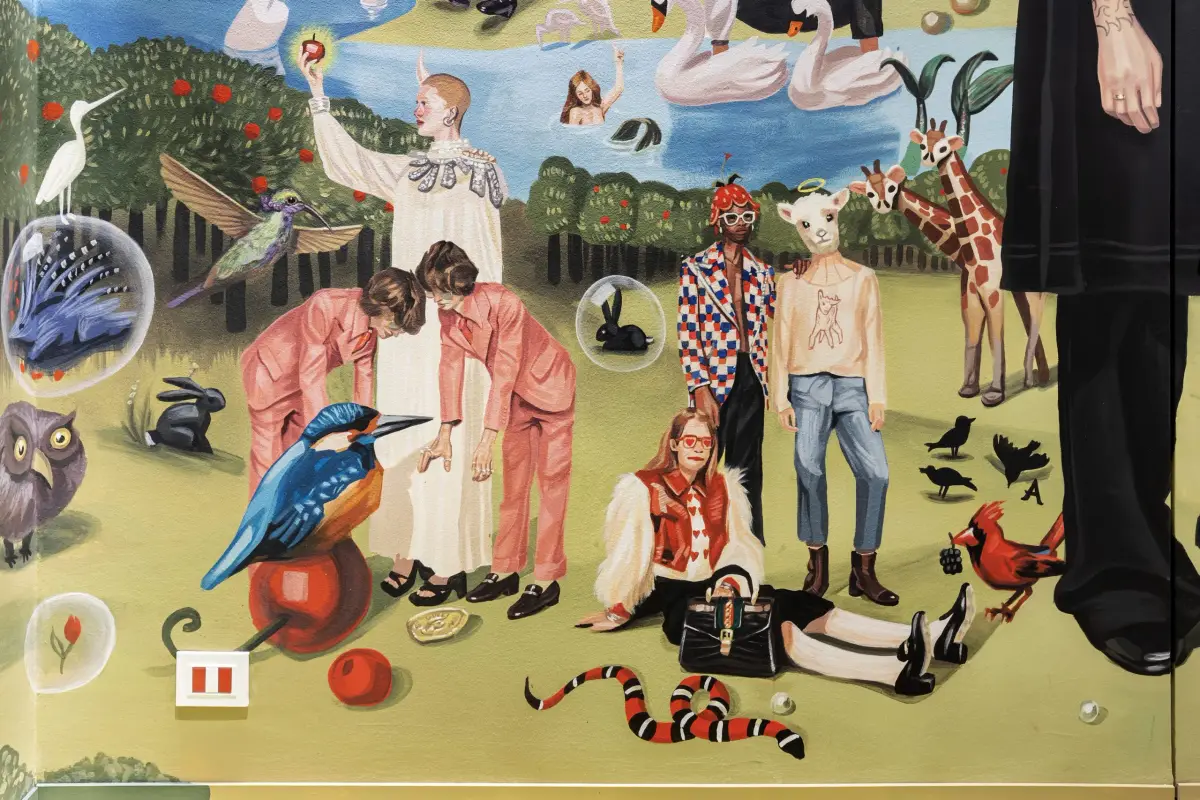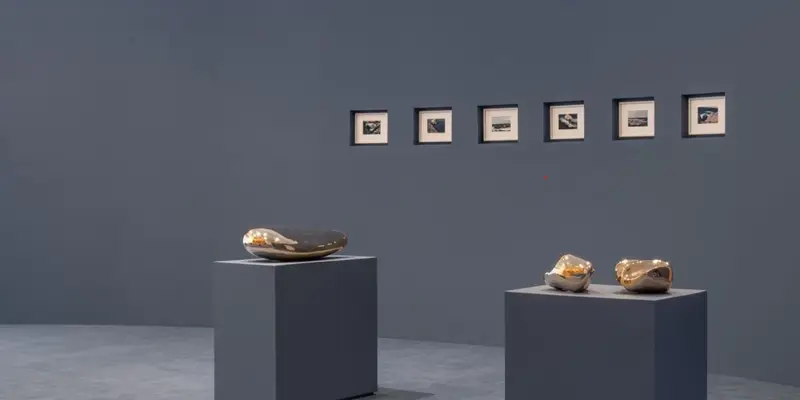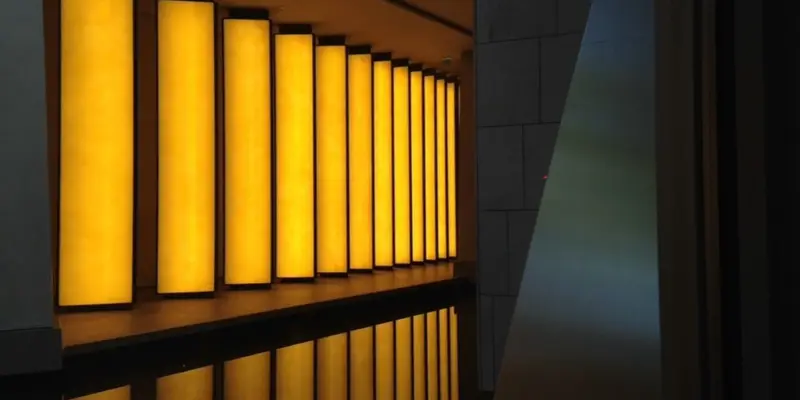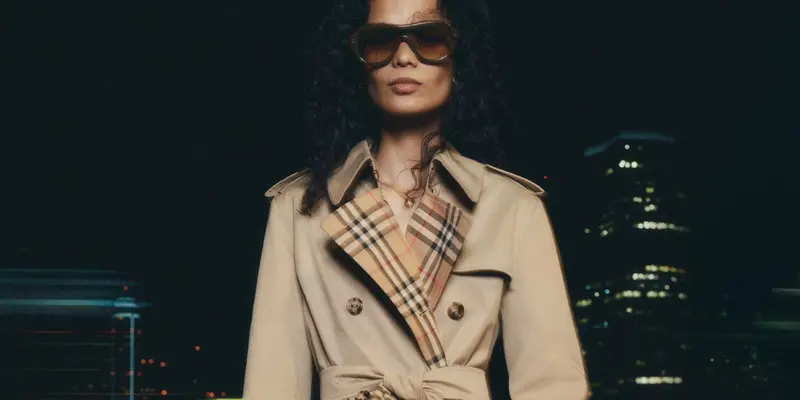
Gucci Storia reclaims Palazzo Gucci at its historic address inside Palazzo della Mercanzia, the 1337 landmark overlooking Piazza della Signoria in Florence. Inaugurated on April 27, the Exhibition spans nine rooms across two floors, weaving together archival objects, Florentine savoir-faire, and Demna's unmistakable creative vision into what the Maison describes as a "museum of museums".
The journey begins with The Thread of Time, an introductory room draped in the tapestries of Gucci Memoria, previously unveiled during Milan Design Week 2026 at the Chiostri di San Simpliciano.
The narrative begins here: 105 years condensed into symbolic form, threading Guccio Gucci through Tom Ford, Frida Giannini, Alessandro Michele, Sabato De Sarno, and Demna himself, who pulls the lineage forward.
Inside the Museum of Museums
Demna conceived Gucci Storia as a sequence of distinct arguments, each room staking its own claim. The tapestries of The Thread of Time read like ancient works at first glance. Linger, and Gucci's entire arc materialises across the fabric. Guccio Gucci begins the story as a porter at The Savoy Hotel in London. Tom Ford's era arrives through Madonna at the 1995 MTV Video Music Awards, wearing his light blue silk blouse and black pants, rendered in near-angelic light. Alessandro Michele appears on horseback. Demna closes the sequence, depicted crafting the red coat from his debut show. The choice of tapestry is deliberate: a Florentine craft form that rose to prominence during the Renaissance, it ties the Maison's identity to the city's textile tradition as naturally as the Horsebit ties to its equestrian mythology.
Ground Floor, Room by Room
The Gallery follows, arranged as a traditional portrait hall. Catherine Opie's photographs of La Famiglia line textile-upholstered walls, expanding the notion of family well beyond bloodline, all the way to the present.
Then the Archive: a room where chronology dissolves entirely. 1960s beauty cases complete with brushes and mirrors sit alongside picnic sets, a bourguignon fondue set, jeweled clutches, swim fins embossed with the GG logo, and a black furry dog kennel. The juxtapositions carry no apparent logic. That is precisely the point. You could spend hours in here.
At the centre of the ground floor, The Manufacture carries the most weight. Gucci Bamboo 1947, Gucci Jackie 1961, Gucci Horsebit 1953 Loafer, and the Dionysus, whose buckle dates to 1970 and originally featured two dragon heads rather than tigers, occupy recessed niches alongside their sketches and prototypes. An original worktable scattered with archival tools anchors the first half of the room. The second half reads as a laboratory: robotic arms test material resilience, one demonstrating how a bag holds firm against a repeatedly shaken mannequin's shoulder. Florentine savoir-faire and industrial precision occupy the same space, in deliberate tension.
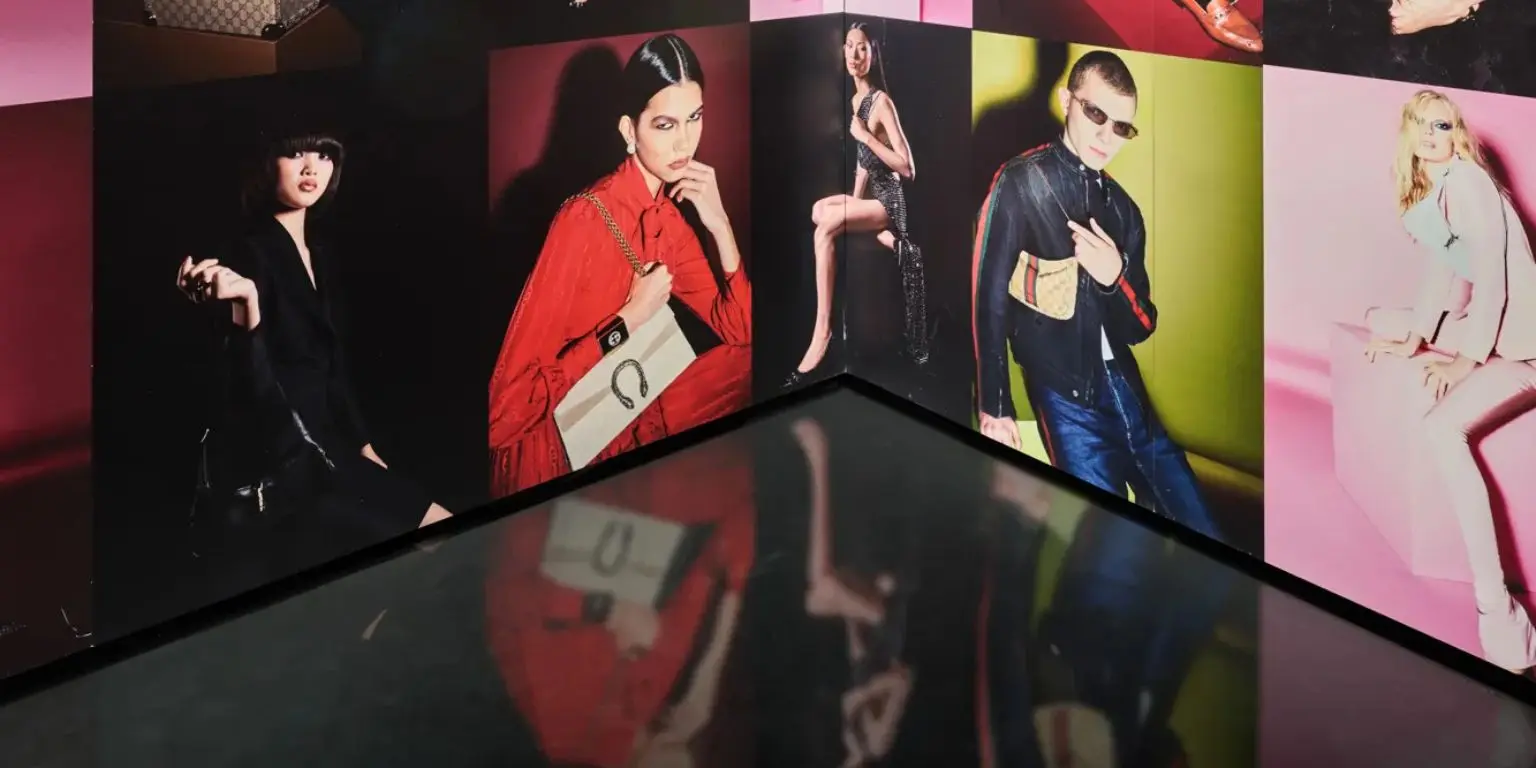
Generation Gucci closes the ground floor with the current campaign, its images filling every wall. At the entrance, Demna's open letter from his debut show. The room places you inside the Maison's present tense, immersive and without apology.
The Second Floor Shifts the Register
Upstairs, The Matter suspends mannequins mid-air in near darkness, the room lit almost entirely by the fabrics themselves. Decades of ready-to-wear surface and recede. The Tom Ford era dominates: the red velvet tuxedo Gwyneth Paltrow wore in the 1990s; Madonna's MTV Video Music Awards look. Alongside them, one of Demna's most recent pieces, a dress so encrusted with embellishment it reads as a mosaic of precious stones.
The Room of Truth arrives as a 1980s office, crystallised in time. A document traces the birth of the Gucci coat of arms. A family tree attempts to impose order on decades of complicated ties. A photograph of Maurizio Gucci reveals a wallet, inside which a coin bearing Guccio Gucci's coat of arms can be glimpsed. A painting of a man on horseback raises the question the room never fully answers: how much of Gucci's equestrian identity is craft heritage, and how much is myth? The portrait of Guccio Gucci by Angelo Cesselon, a painter known for 1950s western movie posters, commissioned by Guccio's own sons, suggests the Maison has always understood that luxury and myth-making travel together.
Then The Oracle closes the journey. The room bleaches to white. A corridor leads to an interactive device that dispenses its answers on a physical card. You might leave with something absurd. You might leave with something that stays with you. Demna designed it that way. As he put it: "There is something deeply interesting in not knowing what you will receive."
The Palazzo Demna Inherited
Previous incarnations of this palazzo carried distinct creative signatures. Frida Giannini inaugurated the space in 2011. Alessandro Michele reimagined it in 2018 as Gucci Garden. Demna absorbs both chapters into a framework that belongs entirely to the present. The Maison's archive remains intact. Its meaning has shifted.
Palazzo Gucci, he stated, represents "Gucci's role as a cultural icon," with each room built to express that role in motion. Walk the full path and the distinction becomes clear. The history of the Maison does not feel curated here. It feels inhabited. As for what comes next, Demna offers nothing: "You will just have to wait and see what we come up with."