Homo Faber 2026 brings more than 500 artisans from over 70 countries to Venice for a month dedicated to contemporary craftsmanship. From September 1 to 30, more than 700 handcrafted objects fill the Fondazione Giorgio Cini on San Giorgio Maggiore, alongside live demonstrations, workshops and a program extending across the city.
This fourth edition, titled An Island of Light, places British artist and stage designer Es Devlin in charge of the artistic direction. Rather than arranging the works as a conventional design exhibition, Devlin uses light, water, mirrors and movement to connect the objects with the hands, materials and techniques behind them.
Step Inside Es Devlin’s An Island of Light
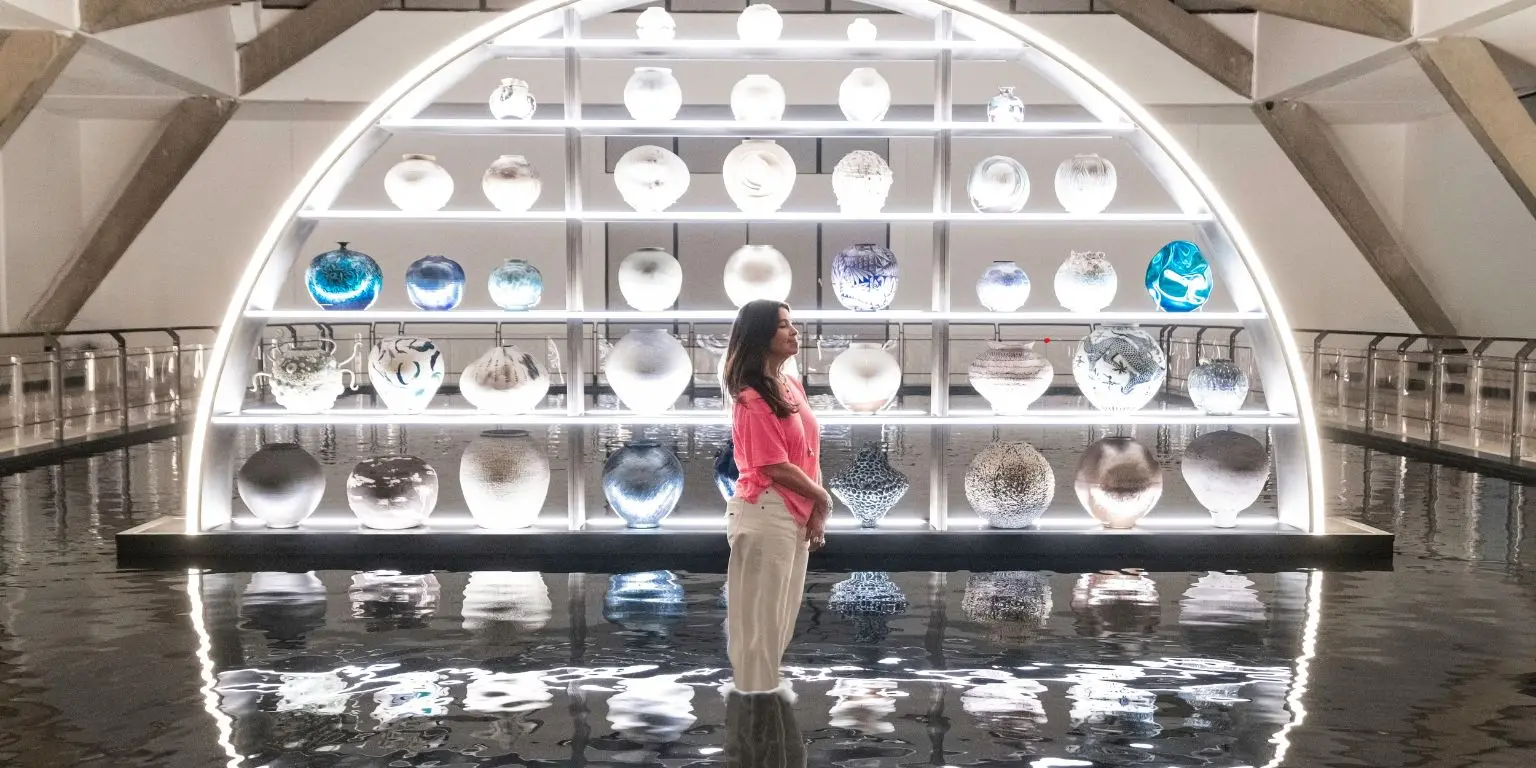
An Island of Light exhibition unfolds through 15 installations across the historic buildings and grounds of Fondazione Giorgio Cini. Each installation looks at craftsmanship through a different material, technique, or relationship with light. Inside the foundation’s former swimming pool, A Full Moon Rising brings together vessels inspired by the Korean moon jar. Ceramic, glass, paper and metal pieces sit around a semicircular structure reflected in the water, connecting an object with centuries of history to the work of contemporary makers.
Elsewhere, A Luminous Ark looks directly to Venice. Chinese artist Wen Qiuwen has turned drawings of Venetian birds by Devlin and her studio into illuminated paper sculptures. Kestrels, herons, egrets and terns hang above the staircase leading to the Palladian Refectory.
Color takes over A Rainbow of Forms. Glass, enamel, resin and other materials appear on mirrored shelves and rotating bases beneath a mirrored ceiling. Underfoot, a rug designed by Devlin from Goethe’s Theory of Colours was handmade by Jaipur Rugs.
Watch the Artisans at Work
Throughout September, artisans work inside the exhibition spaces. You can watch Simone Crestani sculpt glass at miniature scale, Joël Laplane make a concert guitar, and Swiss ceramicist Laurin Schaub build patterns in clay using the Japanese nerikomi technique.
The program runs across disciplines and continents. Colombian artisans Gilberto and Óscar Granja demonstrate Barniz de Pasto, while Chinese artist Inkgo Lam works with bamboo. Eshraq Alabrash carves architectural forms connected to Syrian heritage, and Anya Midori turns sheets of paper into micro-origami sculptures.
You can also move from watching to making. Workshops introduce Japanese techniques including kintsugi, where broken ceramics are repaired with lacquer and gold powder, and hanko, the carving of traditional wooden stamps.
Follow Homo Faber Across Venice
San Giorgio Maggiore is only the starting point. Homo Faber in Città takes craftsmanship into Venice itself throughout September. Around 140 artisan workshops form part of the wider city program, giving you another way to discover Venetian makers beyond the main exhibition.
At Casa Sanlorenzo, overlooking the Basilica di Santa Maria della Salute, two exhibitions join the program. One focuses on master artisans from Venice and the Veneto, selected by Artemest. The second presents craftspeople from Luxembourg through De Mains De Maîtres Luxembourg.
The city program turns Homo Faber into something you can follow beyond a single afternoon at Fondazione Giorgio Cini. Visit the main exhibition first, then use the wider program to find the workshops and makers behind Venice’s own traditions.
Stay for Lunch at A Glasshouse Restaurant
Craftsmanship also reaches the table. For Homo Faber 2026, Local Venezia oversees the event’s dining program. At A Glasshouse Restaurant, set inside a glass structure created for the biennial, Local’s head chef Salvatore Sodano serves three tasting menus built around Venetian ingredients and contemporary interpretations of local creations.
One of those menus also brings Tuscan winemaking into the story. Casanova di Neri, the Montalcino estate founded by Giovanni Neri in 1971, has placed its Brunello di Montalcino Tenuta Nuova 2020 on the restaurant’s wine list. The wine accompanies one of the three tasting experiences.